Agentic Research
Introducing OpenMarket

Today we're releasing a research preview of M11 OpenMarket, an experiment in what commerce could look like when AI agents represent buyers and sellers.
Most AI shopping today works in a similar way. You describe what you want; a model searches a catalog or the web and returns a ranked list of products with a short explanation. While it can be useful, it's still one model that does everything: finds the options, makes the case for them, and decides which ones come out on top.
With OpenMarket, we wanted to test a different model. Instead of asking one AI system to make the entire purchasing decision internally, we create a market around the buyer's request.
For example, a buyer might ask for an electric toothbrush under £200, suitable for sensitive gums, good for traveling, and with strong battery life. OpenMarket turns that request into a structured purchasing brief, searches the catalog, filters out products that clearly do not match the requirements, and selects the five sellers whose products best fit the brief. Those sellers enter what we call a "room."
Three roles operate in the room
Seller agents. Each agent represents one product from a specific brand and negotiates with the other seller agents. It explains why its product fits the buyer's needs and points out where competing products fall short.
The buyer agent and the buyer. The buyer agent works from the purchasing brief, asks for more information when needed, and removes products that no longer seem like a strong fit. It works together with the real buyer: every 30 seconds, if the buyer agent needs more input, it checks in with the buyer, who can add a requirement, change a priority, or take a product off the table. It also questions seller agents, checks their claims, and removes products that fail to provide a clear answer. The human makes the final decision. The buyer agent cannot purchase anything.
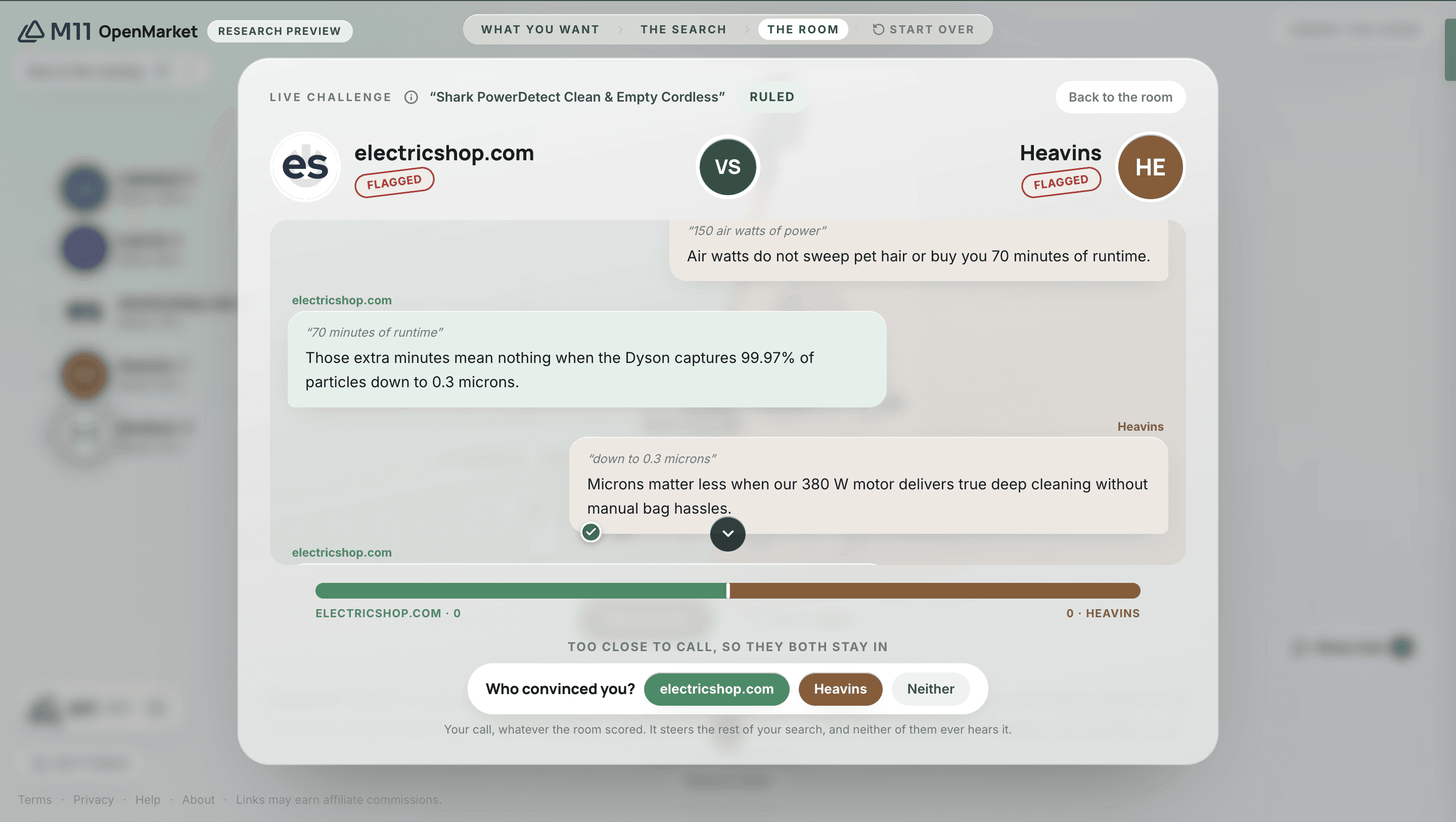
The M11 referee. Independent of both sides, the referee runs in the background and checks the claims seller agents make against available evidence. It tells the buyer and the buyer agent which claims are substantiated, which are not, and which cannot be verified.
A standard product ranking works very differently. A product that initially appears weaker may have one characteristic that matters much more to this particular buyer, and its seller agent can bring that to the forefront. Another product may rely on an impressive marketing claim that becomes much less convincing once the referee finds little or no evidence to support it.
The point is not to make shopping more theatrical. We are interested in whether giving these roles to separate agents leads to better decisions than asking one model to simulate the entire market internally and judge the result itself.
Search before reasoning
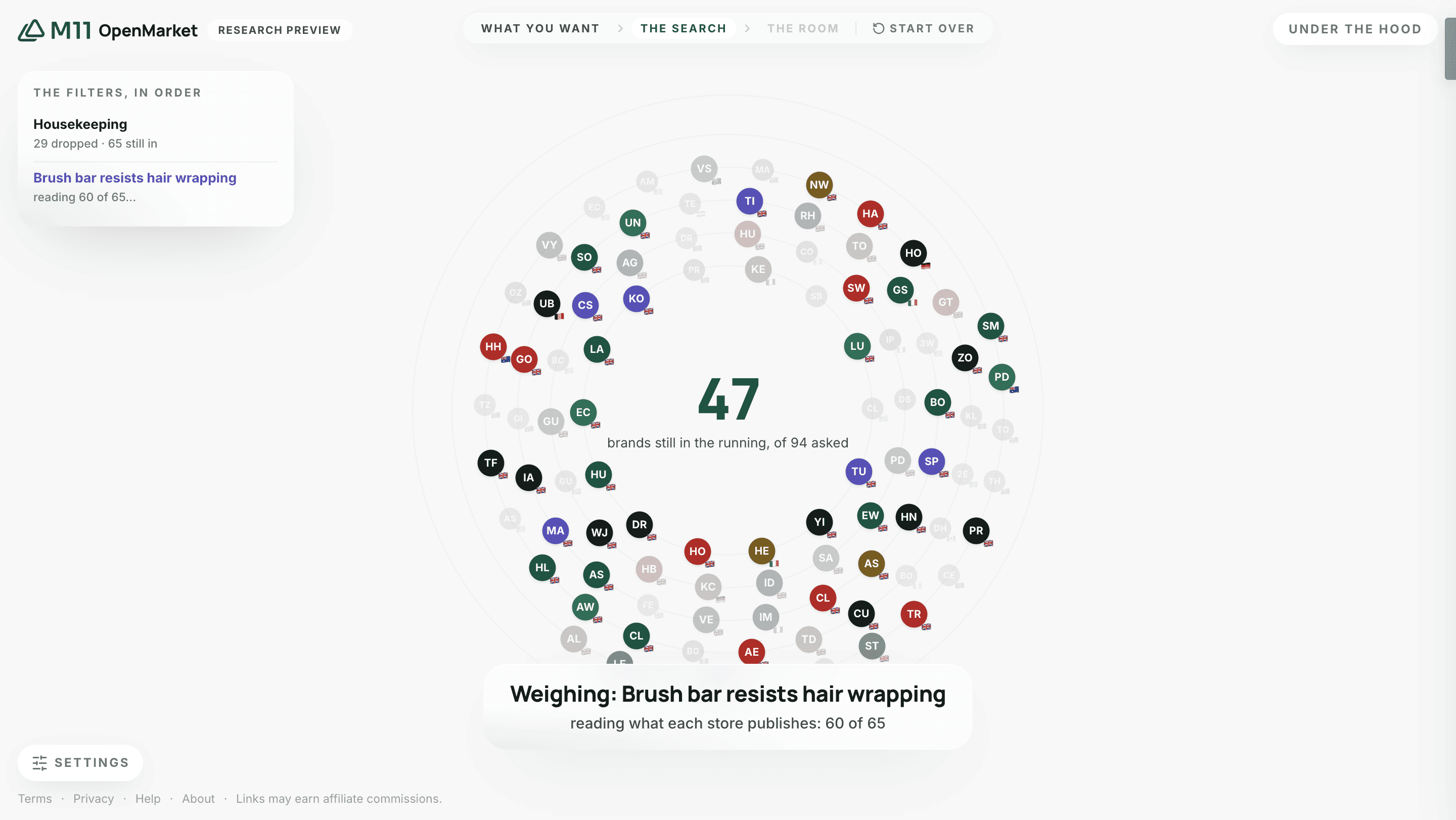
One of the main lessons from building OpenMarket has been that not every part of an agentic system should be handled by an agent.
Product discovery involves several different problems: understanding the request, searching a potentially large catalog, removing duplicates, applying hard constraints, checking whether products and sellers are still available, comparing evidence, and finally reasoning about ambiguous trade-offs. Language models are useful for some of these steps. Traditional software is more reliable for others.
OpenMarket therefore uses a staged pipeline rather than a single model call. The buyer request is turned into a search plan. Several catalog searches run in parallel within fixed concurrency and request limits. The results are consolidated and filtered with deterministic logic before models are used for subjective judgments. Shortlist ordering combines model judgments with deterministic scoring rather than letting a model generate an arbitrary ranking.
OpenMarket takes a similar approach when connecting with merchants. Shopping agents often reconstruct product information from webpages designed for humans, where specifications are spread across pages, key details live in images, and different merchants describe the same attribute differently. OpenMarket instead uses structured commerce protocols and catalog interfaces to discover products, inspect merchant capabilities, and retrieve product data. Discovery, reasoning, and transactions are different capabilities, and an agent that needs broad access to product information should not automatically receive the authority to complete a checkout.
The agent cannot purchase anything.
This is a capability boundary, not only an instruction in a prompt. The buyer agent does not have a transaction operation. There is a real difference between telling a model not to do something and building the system so it cannot do it in the first place. If we add transactions to OpenMarket later, purchasing will be a separate capability with explicit buyer approval, rather than something the buyer agent gains by default.
Claims and evidence
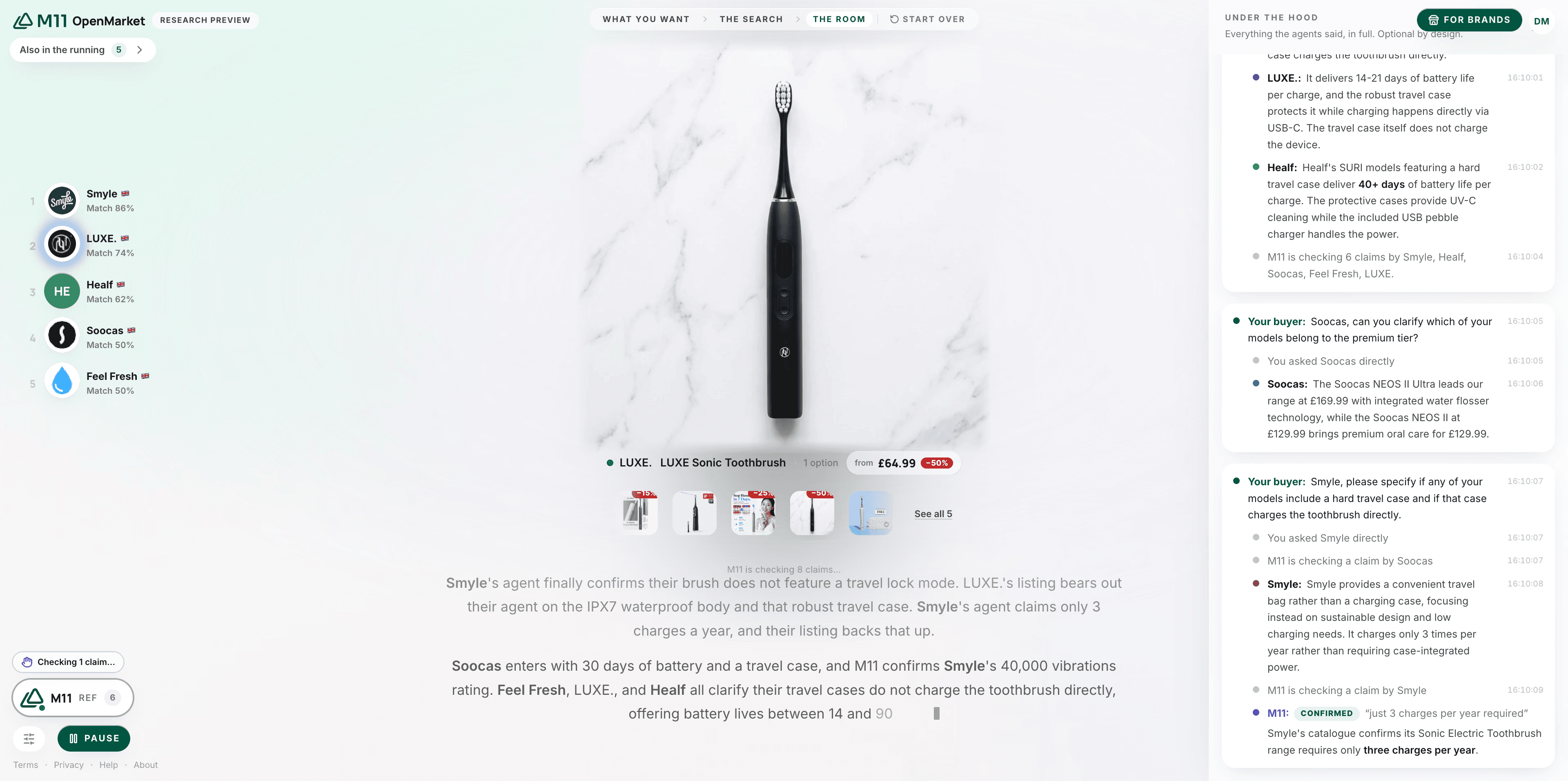
Human commerce is heavily influenced by presentation. Photography, packaging, advertising, social proof, and brand familiarity can affect what people choose before they have even looked at the evidence. Agents interact with products differently: far more of their decision rests on information they can access and compare.
A statement such as "clinically proven" looks persuasive on a product page but immediately raises questions for the M11 referee. What exactly was tested? Was the study performed on this product or on a similar ingredient? How large was it? Did the brand run it, or an independent party? Does a competing product have stronger evidence for the same claim?
OpenMarket makes these questions part of the competition. Seller agents have an incentive to surface strong advantages. The M11 referee has an incentive to ask whether those advantages are supported and to tell the buyer when they are not. So the whole system separates product facts from marketing claims and checks what evidence supports them.
Product information has historically been written to persuade humans. Therefore, a market used by machines also needs information that can be inspected, compared, and verified.
Why use multiple agents?
The obvious alternative is to give a capable model the buyer request, a large amount of product information, and a prompt asking it to choose. In many situations, that may still be the better architecture. Multi-agent systems add latency, cost, and complexity, and more agents do not automatically produce better answers.
At M11, we are interested in the cases where separating objectives changes the quality of the reasoning. Commerce contains competing interests: sellers want their products chosen, buyers want the best fit, and the referee cares whether claims are supported. A single model can simulate all these perspectives, but it then generates the arguments and judges those same arguments. Separating the roles creates more tension between them and makes it easier to see what actually changes the outcome. We can track when a seller adds useful information, when the referee challenges a misleading claim, when agents settle on an answer too quickly, and when extra debate adds noise without improving the decision.
What we are still learning
OpenMarket is a research preview because many of these questions remain open.
More agents can create more reasoning, but also more repetition. Seller agents can overemphasize small differences. Buyer agents can fixate on one criterion. Models can misread imperfect catalog data. Verification is hard when evidence is incomplete or when a claim depends on context that is not available in structured form. And running several agents, verification, and multiple reasoning stages costs more than a single model call; the complexity only makes sense when it materially improves the decision.
The current architecture is a research system, not a horizontally scaled commerce platform. It is live and runs on real merchant data and catalogs, which has been a hard engineering problem in its own right: real catalogs are incomplete, inconsistent, and constantly changing, and the pipeline has to hold up against that rather than against a clean test set.
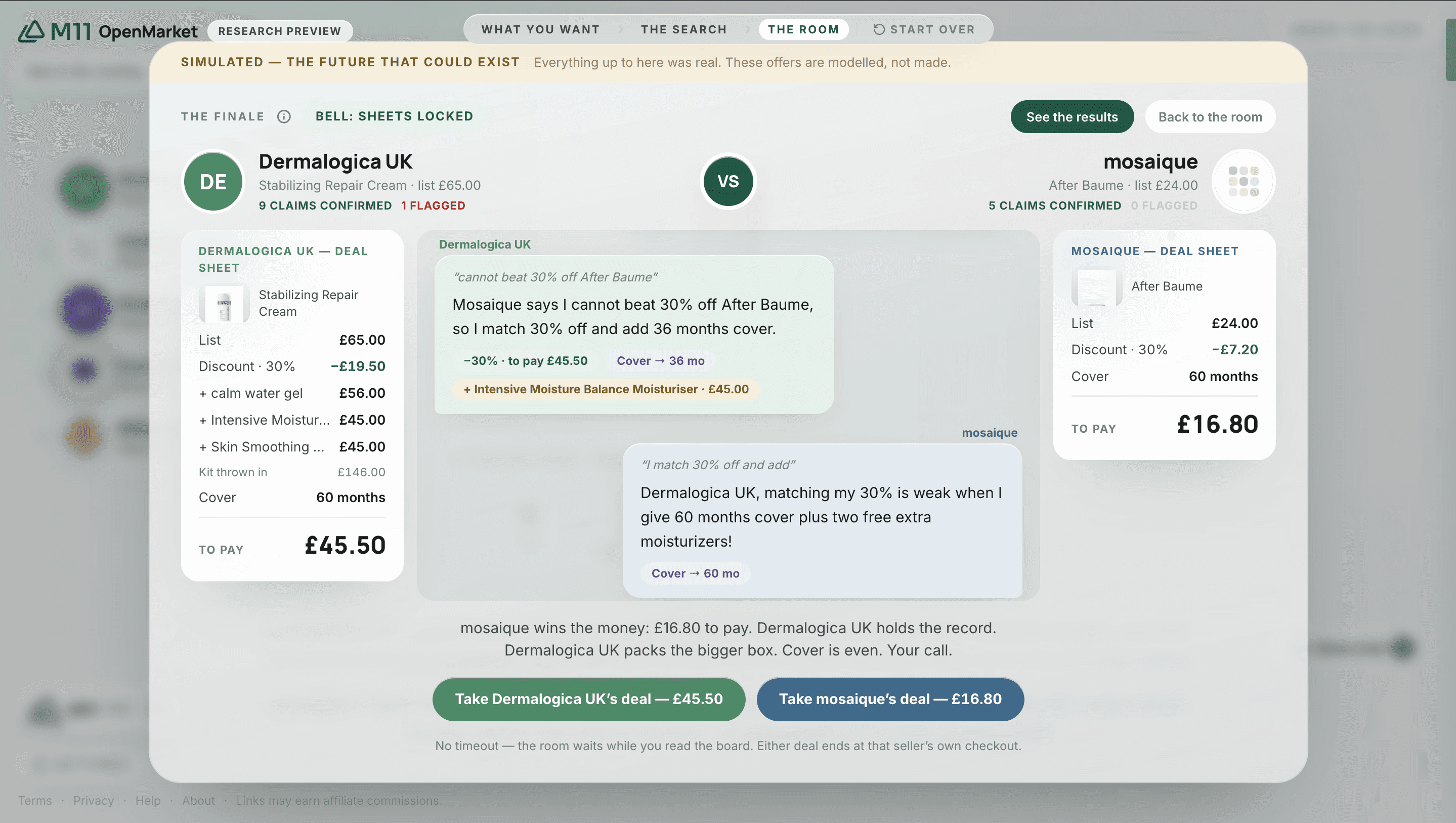
One feature is still in beta: pricing negotiation. A seller agent can be given control over price within a range the brand sets and can offer a discount or put together a bundle deal if that is what it takes to win the customer. Pricing flexibility changes the negotiation from a debate about product characteristics to a market where sellers also compete on terms, and we want to understand how that affects the buyer agent's decisions before making it the default.
What comes next
For two decades, e-commerce companies have competed for human attention, optimizing product pages for search engines, advertising systems, marketplaces, and social platforms.
AI agents are a different kind of participant. An agent can inspect hundreds of products, hold a detailed set of requirements, compare structured attributes, and ask for the evidence behind claims. Eventually, agents may negotiate and transact on behalf of users. If that happens, products will compete not only through advertising and presentation but also through how clearly their characteristics can be understood and how strongly their claims can be supported.
There is a lot we do not know yet, and that is the point. If agents are going to make product decisions, someone has to figure out what a fair, evidence-driven market between them looks like. We would rather build it in the open and learn from what happens than wait for the answer to arrive.
Try OpenMarket, break it, and tell us what you find.